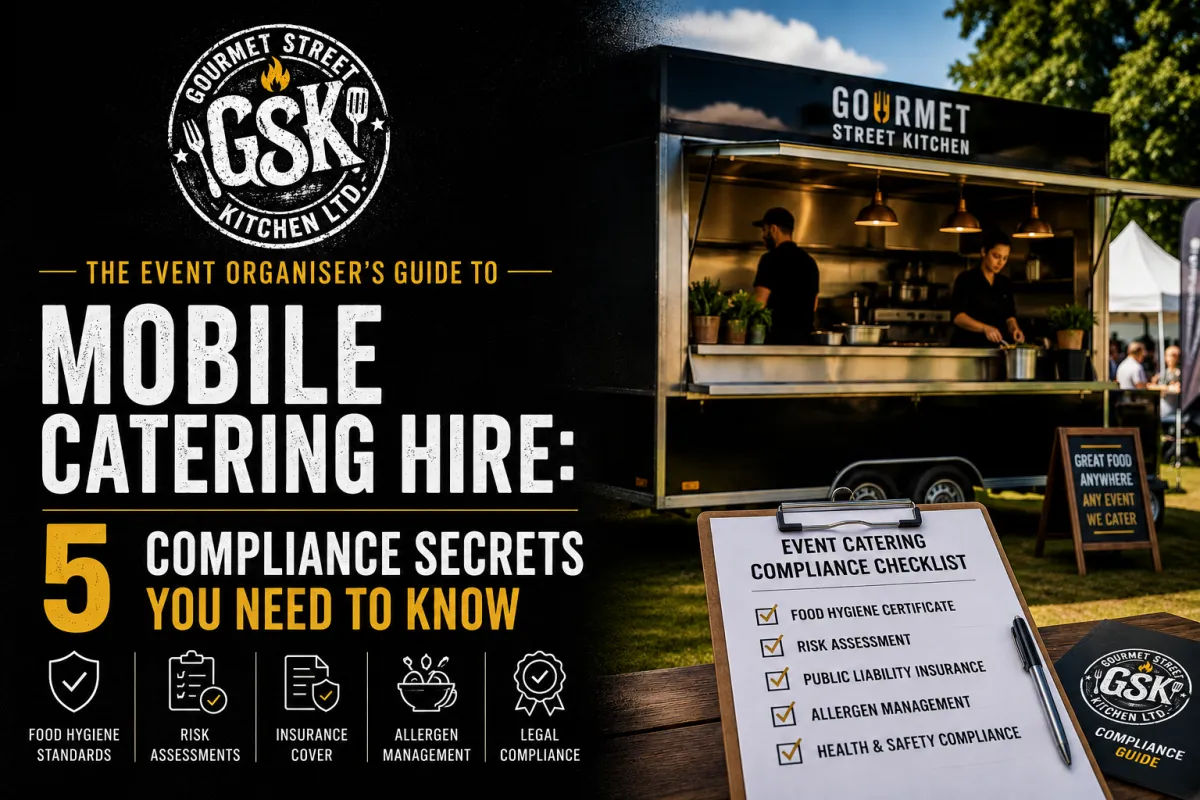
The Event Organiser's Guide to Mobile Catering Hire: 5 Compliance Secrets You Need to Know
The Event Organiser's Guide to Mobile Catering Hire: 5 Compliance Secrets You Need to Know

Planning a high-capacity event: whether it’s a major music festival, a high-stakes corporate launch, or a large-scale public gathering: comes with a mountain of logistical pressure. As an event organiser, your reputation rests on the seamless execution of every moving part, and few parts are as visible (or as risky) as the food service.
When you hire a mobile caterer, you aren't just buying food; you are entering into a professional partnership that must withstand the scrutiny of local authorities, health inspectors, and your own insurance providers. Compliance is the foundation of a successful event. A single oversight in a caterer’s documentation can lead to site closures, legal liabilities, or, worse, a public health incident that tarnishes your brand permanently.
To ensure your next project is a smooth operation, we have compiled the five essential compliance secrets that every professional organiser must verify before signing a contract.
1. The Golden Standard: A 5-Star Food Hygiene Rating
The Food Hygiene Rating Scheme (FHRS) is your first line of defence. While a 3 or 4-star rating is legally "satisfactory," for high-profile events, you should settle for nothing less than a 5-star Food Hygiene Rating.
This rating, awarded by the Food Standards Agency (FSA), indicates that the caterer’s hygiene standards are "very good" across three critical areas:
Food handling (preparation, cooking, and storage).
The physical condition of the catering trailer (cleanliness, layout, and ventilation).
Management documentation (how food safety is managed).
A 5-star rating is a clear signal that the caterer prioritises safety and has the discipline to maintain standards even under the pressure of a high-footfall event. At Gourmet Street Kitchen Ltd, we view our 5-star rating as a badge of honour and a primary reassurance for our B2B partners.
2. Technical Peace of Mind: Gas and Electrical Safety (GSI and PAT)
Modern, fully compliant catering trailers are essentially high-performance commercial kitchens on wheels. This means they carry significant risks related to gas and electricity. As an organiser, you must demand current, professional certification for both.
Gas Safety (GSI)
If a modern, fully compliant catering trailer uses LPG (Liquid Petroleum Gas) for grills, fryers, or ovens, it must have an annual Gas Safety Inspection (GSI) certificate. This must be issued by a Gas Safe registered engineer who is specifically qualified for "Commercial Catering - Mobile Units." It is not enough to have a domestic gas certificate; the rigours of a mobile environment require specialised inspection of hoses, regulators, and flame-failure devices.
Electrical Safety (PAT Testing)
Every piece of portable electrical equipment: from coffee machines to induction hobs: must undergo Portable Appliance Testing (PAT). Additionally, the unit’s fixed wiring should have a current Electrical Installation Condition Report (EICR). This ensures that your event’s power grid isn't compromised by faulty equipment and, more importantly, that staff and attendees are protected from electrical hazards.
3. The Management Backbone: Risk Assessments and HACCP
Professional catering is a science, not just an art. To manage the complexities of high-volume service, a caterer must provide a Hazard Analysis and Critical Control Point (HACCP) plan.
HACCP is a management system in which food safety is addressed through the analysis and control of biological, chemical, and physical hazards. A robust HACCP document will outline:
How temperatures are monitored during peak demand.
Cross-contamination prevention strategies.
Allergen management protocols (critical for modern corporate catering).
Alongside HACCP, you need a site-specific Risk Assessment. This document identifies potential dangers: such as fire risks, trip hazards around the catering trailer, or crowd flow issues: and details the steps taken to mitigate them. A caterer who can provide these documents instantly is a caterer who understands the logistics and crowd flow demands of large-scale events.
4. Protecting Your Liability: Insurance Limits that Scale
Insurance is where many smaller vendors fall short. For a small private party, a £1m Public Liability Insurance (PLI) policy might suffice. However, for major public events and festivals, the industry standard is significantly higher.
Most local authorities and large-scale event promoters now require a minimum of £5 million to £10 million in Public Liability Insurance.
This insurance protects you against claims for injury or property damage caused by the caterer’s operations. You should also verify that the caterer holds Product Liability Insurance (specifically for food-borne illnesses) and Employer’s Liability Insurance (if they have staff on-site).
When you work with Gourmet Street Kitchen, we provide a full compliance pack as part of our event organiser services, ensuring our insurance levels align perfectly with your venue's requirements.

5. The Legal Foundation: Local Authority Registration
Every mobile food business in the UK is legally required to be registered with their home Local Authority. This registration is mandatory at least 28 days before trading begins.
As an organiser, you should ask for proof of registration. This confirms that the business is a legitimate entity known to environmental health officers and is subject to regular, unannounced inspections. It prevents "fly-by-night" operators from entering your site and ensures that the business operates within the established UK food safety framework.
Why Compliance is Your Best ROI
Choosing a caterer based solely on their menu or their price is a common mistake. A cheap caterer often saves money by cutting corners on the very compliance points listed above.
Support your business by choosing a partner that prioritises reliable, efficient, and professional standards. When the catering is compliant, you remove the pressure of potential inspections and legal complications. You gain a dependable service that reflects the quality of your entire event.
At Gourmet Street Kitchen Ltd, we specialize in high-capacity modern, fully compliant catering trailers that are fully UK food safety compliant. Our modern fleet: from our Oriental Noodle Bars to our Vintage Barista Coffee services: is designed for rapid setup and breakdown without sacrificing a single detail of safety or quality.
Ready to secure a compliant catering partner for your next event?
Don't leave your event's safety to chance. Contact us today to discuss your requirements and receive a comprehensive quote and compliance pack. Our team is ready to provide a bespoke, seamless catering solution that aligns perfectly with your brand and safety standards.
Visit our website: gourmetstreetkitchenltd.co.uk
Get in touch: Contact Us
FAQ: Mobile Catering Compliance
Q: Do I need to check every single document myself?
A: Most professional event organisers use a "Compliance Checklist" as part of their onboarding process. You can request a "Compliance Pack" from your caterer which should include their FHRS rating, insurance certificates, GSI/PAT certificates, and HACCP plan.
Q: What happens if a caterer doesn't have a 5-star rating?
A: While a 3 or 4-star rating is legal, it indicates areas where "improvement is necessary." For large-scale events where risk management is paramount, a 5-star rating provides the highest level of reassurance.
Q: Is PAT testing mandatory every year?
A: Most industry bodies, including NCASS, and major event organisers require annual PAT testing for all equipment used in a commercial, mobile environment.